Idea and Purpose
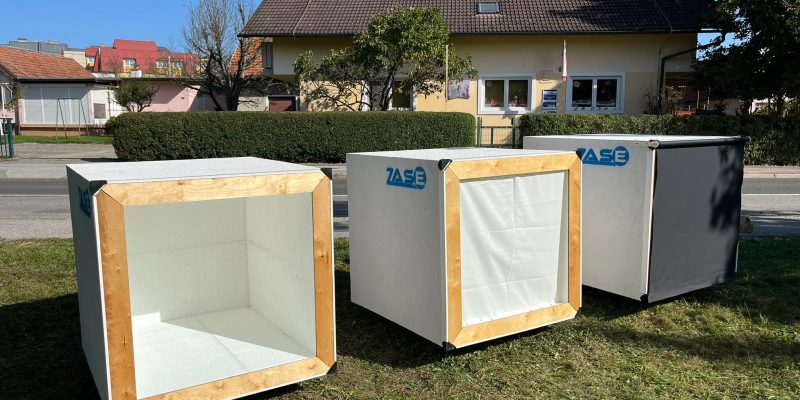
The “Solar Village” project is a research initiative that examines the impact of external and internal shading on room temperatures based on cardinal directions. We use polystyrene cubes representing buildings, positioning them in all four directions (north, south, east, and west). One cube has external shading, another has internal shading, and the third is without shading. Additionally, the first “Solar Village” has already been established in Portugal, where we assisted the Portuguese team in setting it up and passed on knowledge for further dissemination. The project involves partners from various parts of Europe, including Portugal, Serbia, Italy, Turkey, and Latvia, as we aim to study the effects of shading in different climates.
The goal of the project is to explore how the use of appropriate shading can help reduce indoor temperatures and consequently lower energy consumption for cooling. The collected data enables students to calculate thermal resistance and heat flux from the environment into the cubes. Our objective is to demonstrate how shading glass surfaces can reduce the need for cooling energy and apply this knowledge in designing energy-efficient buildings.
Co-financing through the Erasmus+ program has allowed us to conduct research within a broader European context. The project’s conceptual leader is Mr. Marko Novak, chairman of the board of the Slovenian Real Estate Association – FIABCI, who continuously supports the initiative.
Students and professors from the Ptuj School Center participate in conducting measurements and data analysis. A significant aspect of the project involves electronics and sensor technology, designed by the company ZASE d.o.o., enabling data transmission to a website and making the results available to visitors on a display at the project site.
Students will acquire knowledge about measuring temperature variations, calculating thermal resistance, and analyzing heat flux into the cubes. They will learn to use advanced technology for data analysis while discovering sustainable solutions for constructing energy-efficient buildings. Additionally, they will develop teamwork skills and gain experience in using sensor technology for obtaining practical results.
The project includes partners from different countries to assess the effects of shading in various climates. The company Dewesoft assists with logistics and consultancy, ensuring the successful implementation of the project. The first prototype was already installed opposite the Ptuj School Center, where results showed that shading could reduce temperatures by up to 30 degrees Celsius. Our goal is to contribute to sustainable and energy-efficient construction through such research.